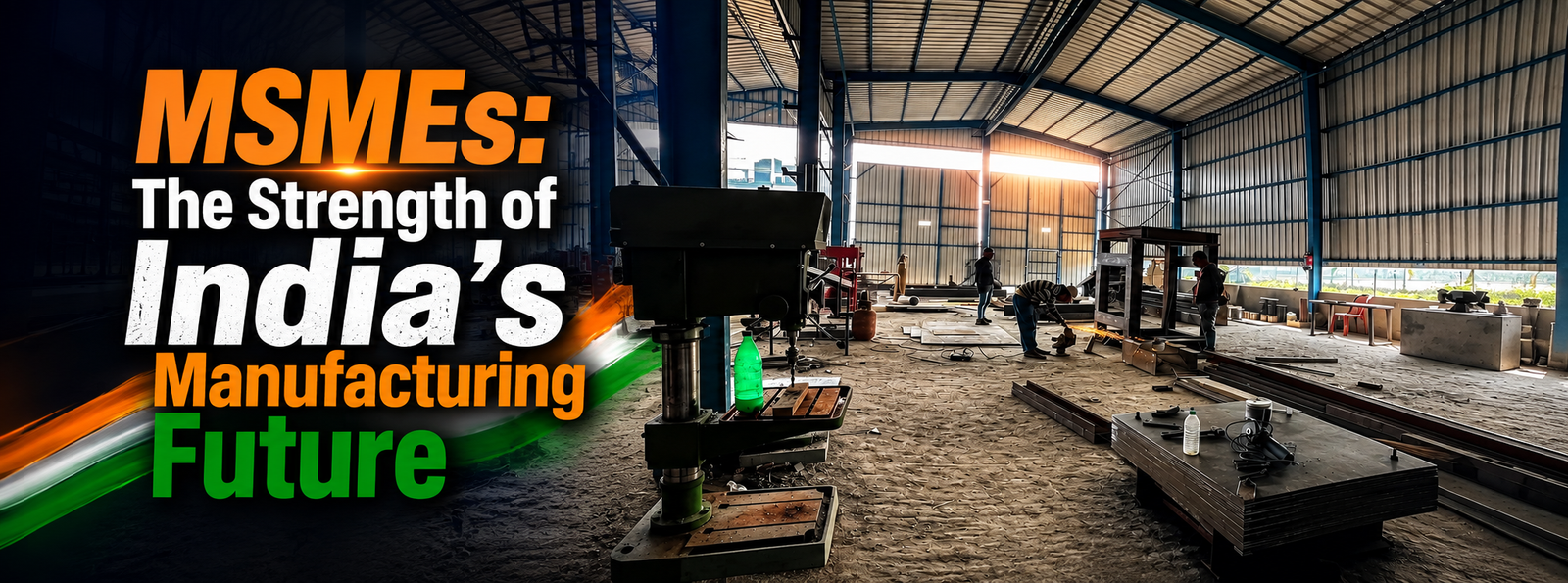
India is entering a decisive phase of economic transformation, and at the heart of this transformation lies a sector that is often described as “small” but is enormous in its impact—the Micro, Small and Medium Enterprise (MSME) sector. MSMEs are no longer simply suppliers to large industries or employment generators in smaller towns. They are becoming important drivers of manufacturing, exports, innovation, technology adoption and regional development. Their evolution could determine how successfully India moves towards a more self-reliant, globally competitive and manufacturing-led economy.
The latest national figures underline this importance. According to the Economic Survey 2025–26, MSMEs account for approximately 31.1% of India’s GDP, 35.4% of manufacturing output and 48.58% of exports. The sector has therefore moved well beyond its traditional role as a support system for the economy; it is now one of the principal engines of India’s industrial growth.
From Small Businesses to Strategic Industrial Partners
The nature of Indian MSMEs is changing rapidly. Earlier, many enterprises operated with limited technology, local markets and informal systems. Today, increasing numbers are adopting digital payments, enterprise software, automation, computer-aided design, modern machinery, quality certifications and e-commerce platforms.
This transformation is particularly significant for manufacturing. A modern MSME can serve as a highly specialised supplier of precision components, engineering products, fabricated structures, electrical systems, industrial equipment and specialised services to much larger companies.
This creates a powerful model of industrial development. Large companies provide scale and global market access, while MSMEs provide flexibility, specialised capabilities and speed. Together, they create deeper domestic supply chains and reduce dependence on imported components.
The growth in MSME exports demonstrates this changing role. The value of MSME exports increased from approximately ₹3.95 lakh crore in 2020–21 to ₹12.39 lakh crore in 2024–25, while the number of exporting MSMEs rose from 52,849 to 1,73,350 over the same period.
West Bengal: A Significant MSME Powerhouse
West Bengal provides an especially interesting picture of India’s MSME future. The state has one of India’s largest MSME bases, with the sector playing a major role in employment, industrial production and exports, particularly across rural and semi-urban areas.
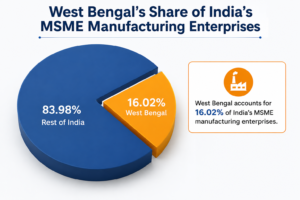
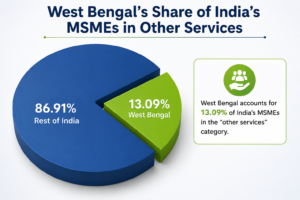
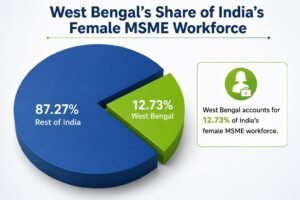
These numbers are significant because they demonstrate that West Bengal’s MSME ecosystem is not limited to traditional small businesses. It represents a broad industrial and entrepreneurial network extending across manufacturing, services, crafts, textiles, engineering, food processing and other sectors.
Formalisation is also accelerating. During the current financial year, the state reports around 4 lakh micro enterprises registered on the Udyam Portal and another 1.33 lakh on the Udyam Assist Platform, taking cumulative MSME registrations to approximately 48.80 lakh.
This formalisation is important because registration brings enterprises closer to institutional credit, government support, procurement opportunities, technology programmes and organised supply chains.
Credit and Technology Are Changing the Equation
Access to finance has historically been one of the biggest constraints for MSMEs. West Bengal’s recent credit figures indicate that this is beginning to change. The state reports that bank credit to MSMEs in the first two quarters of 2025–26 was estimated at ₹1,45,372 crore, representing a 27.83% increase over the corresponding period of the previous financial year.
The state is also increasingly focusing on technology. Its MSME ecosystem now includes initiatives such as Tech Bridge, connecting enterprises with institutions including IIT Kharagpur, the MSME Tool Room and CSIR for access to technology, infrastructure and specialised services. Investor Connect and Credit Sphere are intended to address investment and finance requirements.
The emphasis on clusters is equally important. Common Facility Centres can allow smaller enterprises to access machinery, testing facilities, technology and production infrastructure that would otherwise be difficult for an individual MSME to afford.
The state’s recent industrial procurement initiatives illustrate this direction. Government tenders have included machinery and equipment for fabric, furniture and other industrial clusters, demonstrating a move towards strengthening manufacturing capabilities at the cluster level.
What Does This Mean for India’s Manufacturing Future?
The West Bengal experience offers a useful indication of where Indian manufacturing could be headed.
First, manufacturing is becoming more distributed. Instead of relying exclusively on a few large industrial centres, India can build networks of specialised MSMEs across states and districts. This creates employment closer to communities and strengthens regional economies.
Second, specialisation will become increasingly important. The MSME of the future will not necessarily compete by producing everything. It may become exceptionally good at one component, process, material, technology or engineering solution and become part of a national or international supply chain.
Third, technology will determine competitiveness. Automation, robotics, digital manufacturing, artificial intelligence, data analytics and modern quality-control systems will increasingly become accessible to smaller enterprises. Government programmes that connect MSMEs with technology institutions can accelerate this transition.
Fourth, exports can become a major growth opportunity. India’s MSME-related exports already account for nearly half of merchandise exports. The next stage will be to move from low-value products towards higher-value engineering, precision manufacturing, specialised components and technology-enabled products.
Finally, MSMEs can make manufacturing more inclusive. West Bengal’s high participation of women-headed enterprises is a strong example of how entrepreneurship can spread beyond traditional industrial demographics.
The Road Ahead
The future of India’s MSMEs will depend on more than simply increasing their numbers. The real opportunity lies in helping them grow, formalise, modernise and integrate into larger value chains.
Better access to affordable finance, skilled manpower, technology, testing facilities, infrastructure, intellectual property protection, digital tools and international markets will be essential. Equally important will be faster payments and predictable regulatory systems.
West Bengal’s experience shows what is possible when formalisation, credit, technology, cluster development and entrepreneurship are brought together. The state’s growing MSME base, strong manufacturing presence and increasing institutional support provide a useful model for the wider Indian economy.
India’s manufacturing ambition cannot be achieved by large corporations alone. It will require thousands of specialised manufacturers, engineering companies, component makers, technology providers and innovative entrepreneurs working together.
The real strength of India’s future may therefore lie not in the size of its individual enterprises, but in the strength of the ecosystem they collectively create. If India’s MSMEs can evolve from small businesses into technologically capable, globally connected and highly productive enterprises, they will not merely support India’s manufacturing revolution—they will help lead it.